The Problem of Suffering: If God Is Good, Why Does This Happen?
The hardest question. No clean answer. But things worth sitting with.
March 14, 2026·10 min read
Honest Questions About Jesus
Nine questions smart people ask about Christianity — explored honestly by a systems thinker who followed the evidence.
- 1Honest Questions About Jesus
- 2The Trinity: How Can Three Be One?
- 3Old Testament God vs. New Testament God: Did He Switch Up?
- 4The Problem of Suffering: If God Is Good, Why Does This Happen?Reading
- 5The Exclusivity of Jesus: What About Everyone Else?
- 6Bible Reliability: Written by Men, Translated Too Many Times, Full of Contradictions
- 7Science and Miracles: Do I Have to Turn My Brain Off?
- 8Hell and Eternal Punishment: A Loving God Tortures People Forever?
- 9The Church and Hypocrisy: Why Are Christians the Worst Advertisement for Christianity?
- 10The Rabbit Holes: Ancient Knowledge, Aliens, and the Occult
This is the one that stops people. Not in a debate way. In a real way. A child gets cancer. A good person loses everything. Someone you love dies for no reason. And the question isn't academic anymore. It's personal.
If God is all-powerful, He could stop it. If God is all-loving, He'd want to stop it. And yet. Here we are.
I'm not going to pretend I have a clean answer to this. Anyone who does is selling something. But I've found some things worth sitting with.
The Question Behind the Question
Before we get into what the Bible says, it's worth noticing what the question assumes.
"If God is good, why does suffering exist?" assumes that a good God would create a world with no pain. But would He? Think about what that world requires.
A world with no suffering is a world with no choice. No risk, no loss, no consequence. Which means no real love, because love that can't choose isn't love. No courage, because courage without danger is just comfort. No growth, because growth without resistance is just existence.
We want a world where love is real and pain is not. But those might not be separable. A world where you can genuinely love someone is a world where losing them can genuinely destroy you. The capacity for one creates the possibility of the other.
That doesn't make suffering good. It means the kind of world where suffering is impossible might also be a world where nothing meaningful is possible.
Free Will Has a Cost
The Bible opens with a choice. A tree. A warning. And the freedom to decide.
"I have set before you life and death, blessing and cursing: therefore choose life." — Deuteronomy 30:19
God didn't create robots. He created beings with real agency. And real agency means real consequences. Humans can choose to love, build, create, sacrifice. Humans can also choose to destroy, abuse, exploit, and ignore.
Most suffering in this world traces back to human choices. War, poverty, injustice, cruelty. We made these. And then we point at God and ask why He allows them.
But the alternative is a God who overrides every bad decision before it happens. Who stops every fist before it lands, every lie before it's spoken, every selfish act before it plays out. That God hasn't given you freedom. He's given you a script.
"Choose you this day whom ye will serve." — Joshua 24:15
Choice is real. And real choice has real weight. God could remove suffering tomorrow by removing freedom today. He doesn't. And that might be the most loving thing about Him.
But He Knew
This is the sharpest version of the objection, and I want to give it its full weight.
God is omniscient. He knew before He created anything that free will would lead to cancer, war, abuse, every terrible thing that has ever happened. He saw all of it before He spoke the first word. And He created anyway.
Isn't that worse? A God who builds a house He knows will burn down?
I've sat with this one. Here's where I land.
Every parent who decides to have a child knows that child will suffer. Not might. Will. They'll experience heartbreak, loss, pain, failure, grief. No parent has a child believing their life will be pain-free. They have the child because they believe the life is worth it. That love, experience, growth, relationship, meaning, all of it, is worth the suffering that will inevitably come with it.
Is that cruel? Most of us would say no. Most of us would say that choosing not to create a life because it would include pain is the less loving option. A life with no possibility of suffering is a life with no possibility of anything real.
God knowing the cost and creating anyway isn't negligence. It might be the deepest expression of believing that what He was creating was worth it. That you are worth it. Not in spite of the pain, but knowing the full picture, the love, the growth, the relationship, the redemption, is something only a being who can see all of it at once is equipped to weigh.
I can't see all of it. Neither can you. That's the honest tension. We're evaluating a decision made with infinite information using our finite frame. That doesn't mean we stop asking. It means we hold the question with some humility about what we might not be seeing.
The Suffering We Don't Want to Trace Back to Us
Free will covers the obvious stuff. War, crime, cruelty. But there's a second layer we don't like looking at.
Cancer. We pump chemicals into our food, our water, our air. We process everything. We engineer substances our bodies were never designed to consume and then mass-produce them for profit. We spray the crops, pollute the water table, fill the products with things we can't pronounce. And when someone gets sick, we ask God why.
Natural disasters. We strip forests that regulate weather systems. We build cities in flood zones and on fault lines. We destabilize ecosystems that took thousands of years to balance. The earth responds, because systems respond to what you do to them, and we call it an "act of God."
I'm not saying every disease is someone's fault. I'm not saying a child with cancer did something wrong. But we've built systems, industrial, agricultural, chemical, environmental, that produce sickness and disaster at scale. And then we point upward and ask why He allows it. How much of what we call "random" suffering is actually the long-tail consequence of choices we made collectively? More than we want to admit.
This doesn't explain everything. But it shrinks the category of "truly inexplicable" significantly. When you account for human evil AND the systems humans built, the amount of suffering you can't trace back to us at all gets a lot smaller.
What About the Rest?
For the remainder, the genetic disorder no one caused, the suffering that genuinely seems to come from nowhere, I don't have a tidy answer. I don't think one exists. And I don't trust anyone who claims they do.
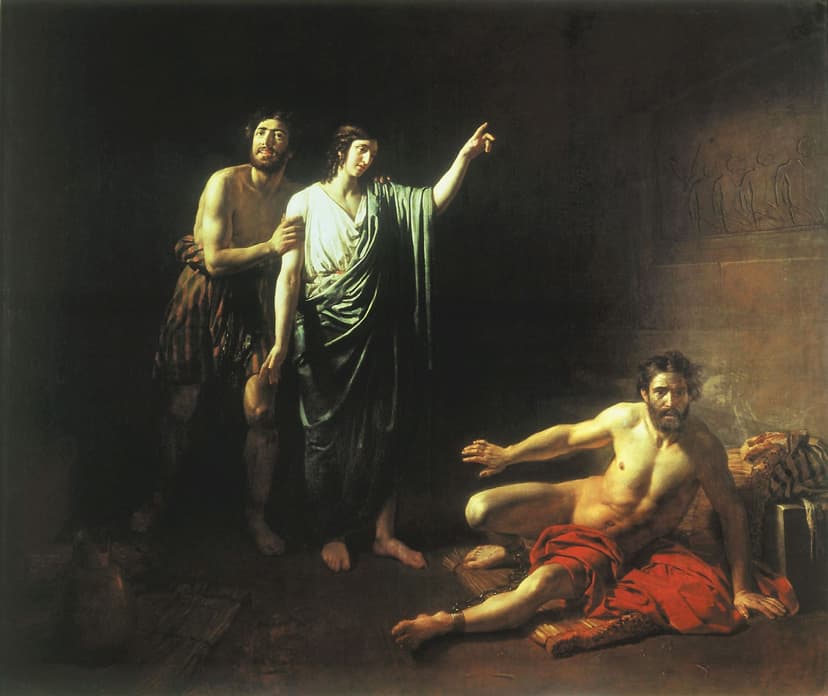
Job. The entire book is about this question. Job loses everything. His children, his health, his wealth. And he didn't do anything wrong. The text says so directly: "a perfect and an upright man" (Job 1:8).
His friends show up and try to explain it. "You must have sinned." "God is teaching you something." "Just repent and it'll get better." God's response to those friends at the end?
"My wrath is kindled against thee, and against thy two friends: for ye have not spoken of me the thing that is right, as my servant Job hath." — Job 42:7
The people who tried to explain Job's suffering with neat theology were wrong. God said so Himself. Job, who sat in the ashes and asked "why" honestly, was the one who got it right.
And when God finally speaks to Job, He doesn't explain the suffering. He asks:
"Where wast thou when I laid the foundations of the earth?" — Job 38:4
That sounds harsh. But read it in context and it's not a rebuke. It's a reframe. "You're asking Me to justify My decisions within the scope of what you can see. But you can't see the scope." Not "stop asking." Just "your frame is too small for the answer."
"I have heard of thee by the hearing of the ear: but now mine eye seeth thee." — Job 42:5
Job doesn't get an explanation. He gets a presence. And somehow that's enough.
God Didn't Exempt Himself
If God sat in heaven and allowed suffering from a distance, the objection would be airtight. What kind of God watches from comfort while His creation bleeds?
But that's not the story.
"He is despised and rejected of men; a man of sorrows, and acquainted with grief." — Isaiah 53:3
God entered it. Not as a tourist. As a participant. Jesus was homeless, rejected, betrayed by friends, abandoned, beaten, and executed. He didn't observe suffering from above. He sat in it.
The shortest verse in the Bible:
"Jesus wept." — John 11:35
He wept at the tomb of Lazarus. He already knew He was about to raise him from the dead. He wept anyway. Not because the situation was hopeless. Because the pain was real. He felt it. Even knowing the outcome, He didn't skip the grief.
And on the cross:
"My God, my God, why hast thou forsaken me?" — Matthew 27:46
God Himself, asking the question we ask. From inside the suffering, not above it.
Whatever suffering is, whatever its purpose or origin, God didn't stand outside it and lecture. He walked into the worst of it. Voluntarily. That doesn't explain why suffering exists. But it tells you something about the kind of God who allows it. He's not indifferent. He's not distant. He's acquainted with grief.
Accounting for the Weight
So let's be honest about what we've actually covered.
A world with real love requires real freedom. Real freedom produces real consequences. That's tier one, human evil. War, cruelty, injustice. We made those.
Tier two, the systems we built. The chemicals, the pollution, the ecosystem destruction, the industrial choices that produce disease and disaster on a scale we don't want to own. We made those too.
What's left after that? The truly inexplicable. The genetic mutation no one caused. The suffering that can't be traced to any human choice or system. That category is real. But it's a lot smaller than the question "why does God allow suffering?" makes it sound.
For that remainder, I don't have a formula. But I've noticed something. The question assumes we'd be better judges of what should and shouldn't happen. That our frame, a few decades on a planet we barely understand, is sufficient to evaluate the decisions of a being who built the thing.
"For my thoughts are not your thoughts, neither are your ways my ways, saith the Lord. For as the heavens are higher than the earth, so are my ways higher than your ways, and my thoughts than your thoughts." — Isaiah 55:8-9
That's not a conversation-ender. It's a scope check. I don't understand everything. And I've found more honesty in admitting that than in forcing an explanation that doesn't hold.
Where I Landed
Jesus told His followers plainly:
"In the world ye shall have tribulation: but be of good cheer; I have overcome the world." — John 16:33
He didn't promise a life without suffering. He promised a presence within it. And then He proved it by walking into the worst suffering any human has ever faced.
I can't explain all of it. But the God I've found in this text isn't the distant observer the objection assumes. He grieves. He weeps. He enters the suffering Himself. He asks the same question from the cross that we ask from our pain.
That doesn't resolve every tension. But it changed who I think I'm talking to when I'm the one asking "why."
I hold this with open hands. This is the hardest question and I want to be honest about that. I don't have it fully figured out. But the evidence I've found doesn't point to an indifferent God. It points to one who is closer to our pain than we realized.
Old Testament God vs. New Testament God: Did He Switch Up?
The Exclusivity of Jesus: What About Everyone Else?

Trenton Jackson builds and writes at the intersection of human systems, business architecture, and design.